
Industry surveys confirm the latest data from the Federal Employment Agency: The automotive services and repair sector in Germany faces a persistent structural skilled worker shortage that acutely threatens operational capability and future growth.
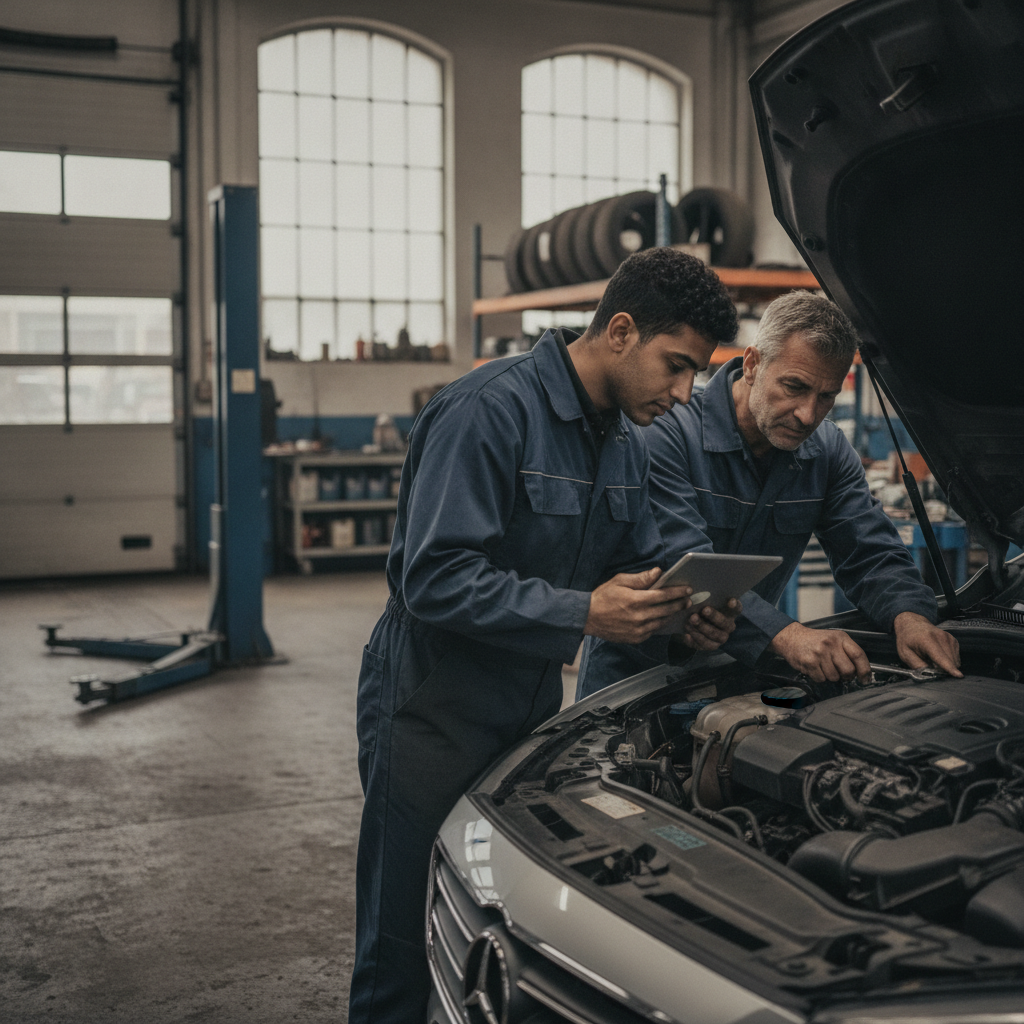
The shortage is already tangible
The numbers are alarming for automotive businesses. In a recent industry survey of managers in vehicle sales and service, more than half of the companies stated that the skilled worker shortage threatens their company's future.
Almost all hiring companies reported open workshop positions, and 61.5% said some roles remain unfilled long-term.
- 12.1% see their company as directly threatened by the shortage.
- 41.4% expect the issue to endanger operations within the next three years.
- 95.7% of hiring companies report open positions in the workshop.
In the automotive trade, the skilled worker shortage is no longer just an HR problem. It is a capacity risk at the very core of the business.
Why the domestic labor market is no longer sufficient
The 2025 data from the Federal Employment Agency classifies occupations in vehicle technology as a persistent shortage profession. The unemployment rate stands at just 2.8%, signaling virtually full employment. At the same time, the ratio of job seekers to open positions at 1.6 shows how scarce the domestic labor pool has become.
One consequence of this situation is that increasingly higher wages are being paid. However, this does not structurally resolve the problem. This development does not create new automotive mechanics but merely intensifies competition among employers.
Higher wages primarily intensify the displacement between employers.
An outlook: The shortage will likely increase
Demographic pressure, growing technical complexity of vehicles, and continued competition for workshop talent all point in the same direction: the bottleneck is structural. Employers are not only competing with neighboring workshops, dealer groups, and fleet operators. They are competing in a labor market where qualified technical personnel are already employed and increasingly mobile.
As a result, the problem constantly infiltrates daily operations. Missed workshop turnovers impact appointment wait times, service quality, and sales support. Existing teams cope with the pressure through overtime, shift adjustments, and administrative overload.
International recruitment becomes a rational capacity strategy
Given this situation, international recruitment is no longer just a symbolic diversification step for automotive companies. It enlarges the actual labor pool. This is especially significant in technical professions within the automotive industry, where training content is often internationally comparable in practical areas such as diagnostics, maintenance, mechanics, and repair procedures.
There are already indications that an increasing number of employers are moving in this direction. In 2025, the proportion of foreign nationals in socially insured employment in vehicle technology professions rose again, following another significant increase the year before.
The immigration framework is more practical than many employers assume
From the employers' perspective, the legal pathway is often less restrictive than anticipated. Automotive mechanics is generally not a regulated profession in Germany, meaning that official recognition is not required to practice the job. While this does not eliminate the need for qualification checks, it can simplify market access compared to highly regulated professions and significantly reduce bureaucratic hurdles.
For recruitment from third countries, the accelerated skilled worker process offers a structured path to coordinate immigration authorities, labor market approvals where necessary, recognition offices, and the visa process.